
Classic Culinary Matcha
Contact our sales team for detailed specifications and application guidance.
- Grade:
- Standard
- Color:
- Varies
- Mesh:
- Standard
- Min. Order:
- Negotiable
Explore products suitable for bakery and baked-goods formulations. Buyers typically prioritize heat stability, post-bake color retention, flavor carry-through, and cost efficiency at scale.
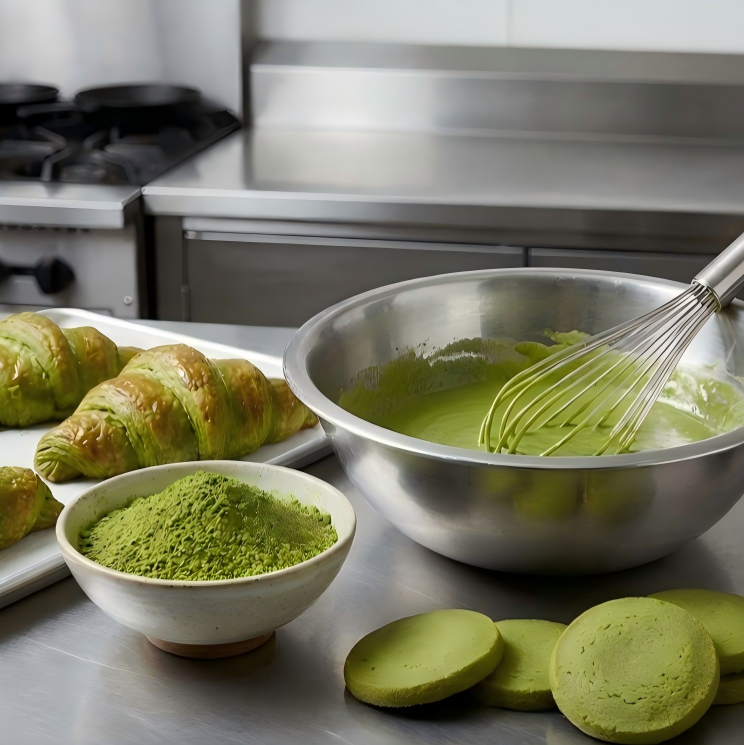
Bakery matcha is used in baked goods — breads, cookies, cakes, fillings, and glazes — where the product is subjected to heat, mixing, and extended processing. Performance after baking matters far more than how the powder looks or tastes in raw form.
The key sourcing questions are: does the color hold after baking? Does the flavor carry through in a sweet or fatty matrix? Is the product consistent across large production batches? Buyers who evaluate bakery matcha using drinking-grade criteria often end up over-specifying and overpaying.
Bakery applications are also more price-sensitive than drinking applications. Buyers should compare cost-per-batch performance rather than premium-grade appearance, and request baked sample trials before committing to volume orders.
Application pages should help buyers move from interest to practical selection. Use the logic below to compare samples, avoid overpaying for the wrong grade, and identify the right product for commercial use.
Do not select by grade name alone. A product suitable for Bakery should be tested in the exact serving, processing, or formulation condition where it will be used.
Compare color, aroma, bitterness, mouthfeel, dispersion, heat response, and consistency depending on the final application. The best product is the one that performs reliably in your system.
Share your target product format, expected flavor direction, packaging plan, monthly demand, and MOQ. This helps narrow recommendations instead of receiving generic samples.
Compare suitable products by application fit, grade, color, mesh range, MOQ, sample availability, and OEM readiness.
Contact our sales team for detailed specifications and application guidance.
Use these points to compare products more accurately and avoid selecting by label alone.
Heat stability and post-bake color retention are the top priorities. After those: flavor carry-through in sweet and fatty matrices, compatibility with your formulation (fat content, pH, moisture), and reliable supply at your batch volume.
Bakery buyers often evaluate matcha using drinking-grade expectations — judging by dry powder brightness or water-based flavor. This leads to over-specification and inflated costs. Evaluate products specifically in your recipe: color, flavor, and cost only matter after baking.
Share your baking temperature and process, your target product type (cake, cookie, bread, filling), expected matcha percentage in formulation, target color outcome, monthly volume, and whether you need OEM support or custom blending for consistency.
These questions help buyers understand how to use application pages as a practical sourcing standard, not just a product category.
No. Application suitability is not the same as grade. A product should be selected by how it performs in the final use case, including color, flavor, texture, process stability, and commercial cost fit.
Test samples in the real formula, preparation method, temperature, sweetness level, milk base, baking process, or finished format. Dry powder appearance and generic tasting are not enough for B2B decisions.
Yes. For OEM and bulk projects, grade selection, blending direction, mesh range, packaging format, and sensory target can usually be adjusted based on your application and order volume.
Provide your target application, product format, flavor direction, color expectation, packaging needs, MOQ, market, and any certification or documentation requirements.
Tell us your target application, flavor direction, packaging format, and MOQ. Our team will recommend suitable options for your sourcing needs.