Struggling with high matcha prices or worried about buying too much stock? Choosing the wrong order size can drain your cash or leave you with stale, faded matcha.
MOQ isn't just a minimum number.1 It defines your purchasing cost, inventory risk, and supplier relationship. A small MOQ is for low-risk testing at a higher price, while a large MOQ secures better pricing for scaling but requires more capital and careful inventory management.
Many people see MOQ, or Minimum Order Quantity, as a simple barrier set by suppliers. I see it differently. It's a strategic choice that shapes your entire supply chain. Making the right choice is critical. Let's break down what this really means for your business and how you can find the perfect balance for your needs.
Is a Low MOQ Always the Best Choice for New Brands?
Excited to launch a matcha product but scared of a huge upfront investment? A low MOQ seems safe, but it might be secretly costing you more in the long run.
A low MOQ is ideal for testing the market and validating your product with minimal financial risk.2 It keeps your initial investment low. However, this safety comes at the cost of a higher per-kilogram price, limited packaging options, and less room for customization.
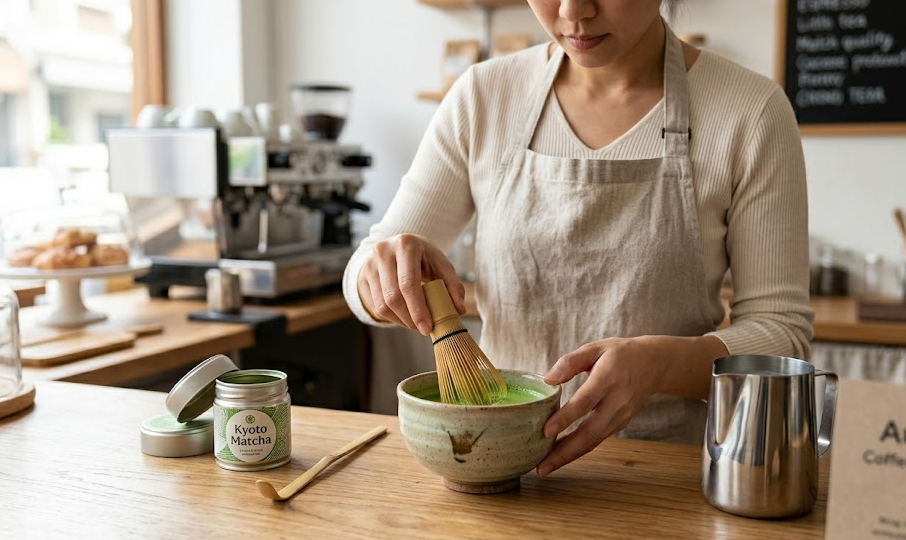
I always tell new clients that MOQ is a "stage-matching problem." If you are a new brand, a single café, or just starting to test a new matcha recipe, your main goal is not cost optimization. It's validation. You need to see if customers like your matcha latte or if your new bakery item sells. This is where a small MOQ, from 1-5kg, is your best friend. It lets you test your ideas without a huge commitment. Of course, the unit price will be higher. This is because a supplier's costs for labor, packing, and administration are spread across a smaller quantity. But think of it as a small price to pay for valuable market feedback. It’s a smart first step, but it’s not a long-term growth strategy.
Low vs. High MOQ Trade-offs
| Feature | Low MOQ (1-10kg) | High MOQ (100kg+) |
|---|---|---|
| Unit Price | Higher | Lower |
| Cash Outlay | Low | High |
| Inventory Risk | Very Low | High |
| Customization | Limited | Extensive |
| Best For | Testing, startups | Scaling, established brands |
How Does a Large MOQ Impact Your Costs and Inventory Risk?
Want to slash your matcha costs? A big bulk order looks tempting. But what if it ties up your cash and the matcha loses its vibrant quality before you can sell it?
Committing to a large MOQ unlocks significant savings through bulk pricing and can give you priority access to production. However, it greatly increases your inventory risk and cash flow pressure. Since matcha quality degrades over time, unsold stock can quickly turn your savings into a loss.
A bigger order almost always means a better price. That's just how bulk sourcing works. When you buy 50kg, 100kg, or more, your per-kilogram cost drops significantly. This is great for profitability. But I always caution clients to think about the other side of the coin: risk. Matcha is a delicate product.3 It's very sensitive to heat, light, air, and moisture. If you buy a 250kg pallet but can only sell 50kg a month, that matcha will be sitting in your warehouse for five months. Even in ideal conditions, its bright green color will fade and its fresh, umami flavor will weaken. The money you "saved" on the purchase price is lost in product quality. Then there's the cash flow. A large order ties up a lot of money in inventory. That's money you can't use for marketing or other growth opportunities. A large MOQ is perfect for established businesses with predictable sales, but a disaster for those who overestimate their demand.
What Does MOQ Mean for Private Label and OEM Matcha?
Ready to launch your own branded matcha? You might be surprised by the high MOQ. This isn't just about the tea; it's about the entire custom production process behind your brand.
For private label or OEM projects, MOQ covers more than just the matcha powder.4 It includes the costs for custom packaging, label printing, formulation, and dedicated production runs. This is why these MOQs are higher, often starting at 50-100kg, to make the project commercially viable.
When you move into private label or OEM, the conversation around MOQ changes completely. It's no longer just about the raw material. The MOQ now represents the minimum viable run for a fully custom product. I've seen brands get frustrated by this, but it’s a matter of production reality. Your supplier has to account for costs beyond the tea itself.5 For example, your custom-printed tins or pouches have their own MOQ from the packaging factory. Setting up a production line just for your specific blend takes time and labor.6 Creating batch-specific Certificates of Analysis (COA) adds another layer of cost. All these expenses have to be spread across the order. That's why a private label MOQ might start around 50-100kg or even require an annual commitment. It's not a barrier; it's the breakeven point. It ensures that the project is feasible for both you and your supplier.7 This is why private labeling is for brands that already have some sales velocity and are ready to scale.
How Should You Approach MOQ with a Supplier?
Don't let the conversation end with one number. Asking "What's your MOQ?" is just the start. To build a real partnership, you need to dig deeper into what that number means.
A professional buyer doesn't just accept the MOQ.8 They ask follow-up questions about pricing tiers, split shipments, batch consistency, private label options, and future scalability. This turns a simple transaction into a strategic discussion about your entire supply chain partnership.
In my view, the MOQ conversation is the start of building a relationship. A professional buyer never stops at "What's your MOQ?". Instead, they use it as a starting point. I always advise asking more:
- What is the unit price at this MOQ? What are the price breaks for larger quantities?
- If I commit to a larger volume, can you split the shipments to help my cash flow and ensure freshness?
- Can you guarantee batch consistency or let me lock in a specific batch for my order?
- Does this MOQ support private label packaging? What are the associated costs?
- Is a Certificate of Analysis (COA) provided for every batch?
- As my business grows, can we renegotiate the MOQ and pricing?
This is how we approach it at MatchaSourcing. We don't just give you a number. We listen to your goals—whether you're testing a product or planning a large-scale launch. We help you find the right balance so you can grow sustainably, one step at a time.
Conclusion
MOQ isn't a barrier but a strategic tool.9 Match your order size to your business stage to balance cost, risk, and quality for a sustainable and successful matcha supply chain.
"Minimum Order Quantity (MOQ): Formula, Tips, & Benefits | NetSuite", https://www.netsuite.com/portal/resource/articles/inventory-management/minimum-order-quantity-moq.shtml. This source explains how MOQ influences purchasing costs, inventory risks, and supplier relationships, providing a broader understanding of its strategic importance. Evidence role: definition; source type: education. Supports: MOQ defines purchasing cost, inventory risk, and supplier relationship.. ↩
"What Is Low MOQ and How Does It Benefit Your Business?", https://sinofinetex.com/what-is-low-moq-and-how-does-it-benefit-your-business/. This source supports the claim that low MOQ is beneficial for market testing and product validation, emphasizing its role in reducing financial risk. Evidence role: mechanism; source type: education. Supports: Low MOQ is ideal for testing the market and validating products with minimal financial risk.. ↩
"Effect of storage temperature on the antioxidant activity and ... - PMC", https://pmc.ncbi.nlm.nih.gov/articles/PMC7406592/. This source explains the sensitivity of matcha to environmental factors like heat, light, air, and moisture, supporting its delicate nature. Evidence role: mechanism; source type: research. Supports: Matcha is sensitive to heat, light, air, and moisture, which affects its quality over time.. ↩
"The Hidden Costs of OEM: Beyond the Price Per Piece – Inspire", https://pressbooks.cuny.edu/inspire/part/the-hidden-costs-of-oem-beyond-the-price-per-piece/. This source explains the additional costs involved in private label and OEM projects, such as packaging and production setup, supporting the claim about higher MOQs. Evidence role: mechanism; source type: education. Supports: Private label and OEM MOQ includes costs for packaging, label printing, and production setup.. ↩
"The Hidden Costs of OEM: Beyond the Price Per Piece – Inspire", https://pressbooks.cuny.edu/inspire/part/the-hidden-costs-of-oem-beyond-the-price-per-piece/. This source explains the additional costs suppliers consider, such as packaging and labor, supporting the claim about private label MOQ requirements. Evidence role: mechanism; source type: education. Supports: Suppliers account for costs beyond raw materials in private label MOQ calculations.. ↩
"How Much Does An Assembly Line Cost? - NewStream Enterprises", https://www.newstreaming.com/how-much-does-an-assembly-line-cost/. This source supports the claim that custom production lines require significant time and labor, explaining why private label MOQs are higher. Evidence role: mechanism; source type: education. Supports: Custom production lines for private label blends require time and labor, contributing to higher MOQs.. ↩
"How Bulk MOQ Flexibility Impacts Private Label Innovation - Medium", https://medium.com/@syedayanali781/how-bulk-moq-flexibility-impacts-private-label-innovation-7633881368ab. This source supports the claim that MOQ ensures feasibility for both parties in private label projects, explaining its role in cost distribution. Evidence role: mechanism; source type: education. Supports: MOQ ensures feasibility for suppliers and buyers in private label projects by distributing costs effectively.. ↩
"How do you negotiate MOQs with suppliers? They are asking for ...", https://www.reddit.com/r/Entrepreneur/comments/1e9r7mf/how_do_you_negotiate_moqs_with_suppliers_they_are/. This source outlines strategies for negotiating MOQ and building supplier relationships, supporting the claim about professional buyer practices. Evidence role: expert_consensus; source type: education. Supports: Professional buyers use MOQ as a starting point for strategic supplier negotiations.. ↩
"Understanding MOQ & Your Supply Chain Strategy - ILG", https://www.international-logistics-group.com/us-en/insights/moq-supply-chain-strategy-162183/. This source explains how MOQ can be used strategically to balance cost, risk, and quality, supporting the claim about its role in supply chain management. Evidence role: definition; source type: education. Supports: MOQ can be used strategically to balance cost, risk, and quality in supply chain management.. ↩