Are you confused by vague matcha grades? These marketing names don't guarantee performance in your product, leading to inconsistent results. Focus on measurable specifications for reliable, repeatable quality.
*The key specifications for commercial matcha powder are measurable data points. These include particle size (D50/D90)1, moisture content2, [color values (Lab)](https://matchasourcing.com/whats-on-the-ultimate-bulk-matcha-buying-checklist-for-importers/)%%%FOOTNOTE_REF_3%%%, and food safety compliance4. These specs, not grade names, ensure consistency and performance in your production line.**
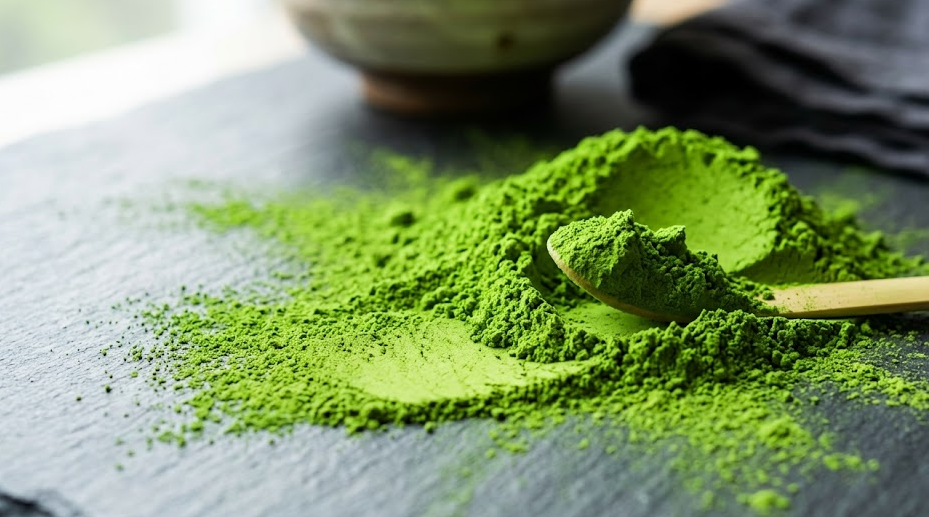
In my experience, many buyers get stuck on grade names. But in a commercial setting, that's the wrong place to start. A beautiful sample means nothing if the bulk order doesn't perform the same way every single time. A "Ceremonial Grade" label won't save your beverage from clumping or your cake from turning a dull brown. That's why we need to look past the marketing and dive into the hard data. Let's break down the specifications that truly matter for your business, starting with how the matcha actually behaves in your product.
How Do Application Specs Define Matcha Performance?
Does your matcha clump, taste gritty, or does the color fade after production? This ruins the customer experience and wastes ingredients, directly hurting your brand's reputation and bottom line.
*Application specifications like particle size (e.g., D50 < 10μm) determine mouthfeel and dispersibility. Color, measured by Lab values, ensures visual consistency. Flavor profiles, defined by catechins5 and amino acids, dictate taste. These specs directly impact the final product's quality.**
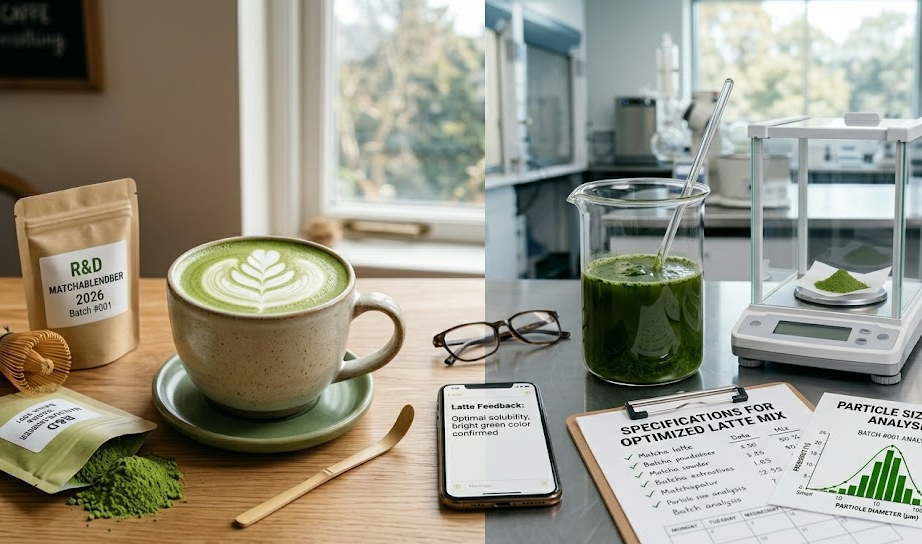
When a client comes to us, they aren't just buying a powder; they are buying a functional ingredient. The success of their final product—be it a latte, an ice cream, or a nutritional supplement—depends entirely on how our matcha performs. This performance is not a matter of opinion; it's a matter of physics and chemistry. That's why we focus on a core set of application-driven specifications that tell the real story of quality.
Particle Size is About More Than Mouthfeel
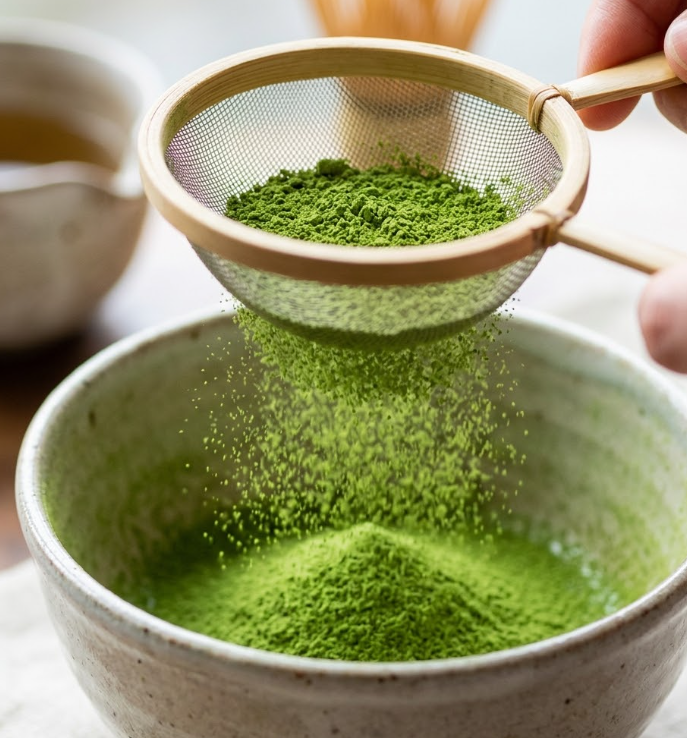
Particle size is one of the first things we discuss. It's measured with values like D50, which represents the median particle size. A fine powder, say with a D50 under 10 micrometers, creates a smooth, creamy mouthfeel in a latte. But it's not just about texture. Finer particles stay suspended in liquid longer and disperse more easily in dry mixes. However, too fine isn't always better. For some applications, a slightly larger particle size might be needed to prevent dust issues in a factory. It's a technical trade-off, and the right spec depends on the end use.
Color Consistency is King
A customer expects their favorite matcha drink to have the same vibrant green color every time they buy it. We can't rely on just looking at it. We use a system called CIELAB, or Lab, to measure color numerically. The 'L' value represents lightness, 'a' represents the green-to-red axis, and 'b' represents the blue-to-yellow axis. By defining a tight range for these values, we can guarantee that the matcha from batch #100 looks identical to the matcha from batch #1. This level of control is essential for brand consistency.
Flavor is a Chemical Fingerprint
Flavor is complex, but it can also be understood through key chemical markers. The pleasant, savory "umami" taste in high-quality matcha comes from an amino acid called L-theanine6. The slight, refreshing bitterness or astringency comes from compounds called catechins5. A good supplier can manage their cultivation and production processes to achieve a consistent balance between these compounds, delivering a reliable flavor profile batch after batch.
| Specification | Why It Matters | Typical Target (Example) |
|---|---|---|
| Particle Size (D50) | Mouthfeel, solubility, suspension | < 10 micrometers |
| *Color (Lab)** | Visual appeal, batch consistency | L > 40, a < -10, b* > 15 |
| Moisture Content | Shelf life, flowability, clumping | < 5% |
What Safety Standards Must Commercial Matcha Meet?
Are you worried about contaminants in your ingredients? A product recall due to a safety issue can destroy your brand overnight and create serious legal problems. This is not a risk worth taking.
Commercial matcha must meet strict food safety standards. This includes limits for total plate count, yeast, and mold. It also requires testing for heavy metals like lead and pesticide residues to comply with regulations in markets like the EU, US, and Japan.
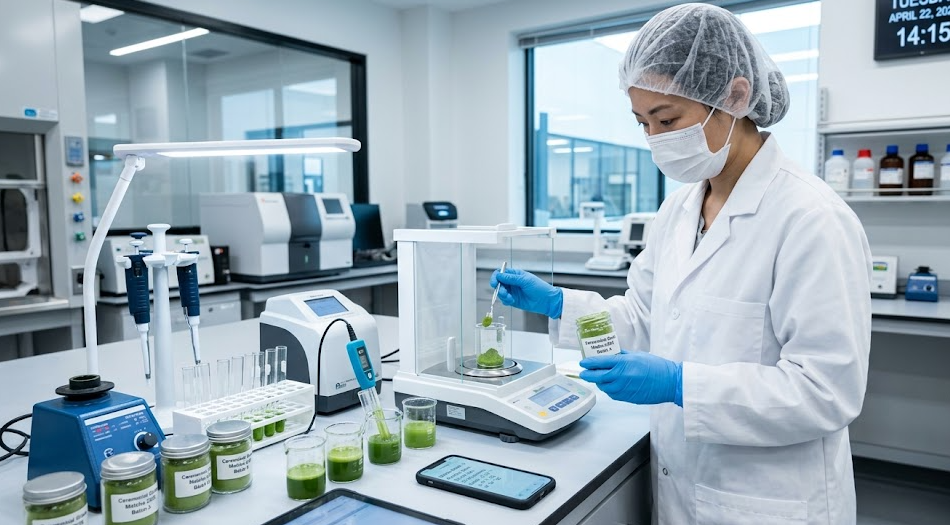
Food safety is the foundation of everything we do. Before we even talk about color or flavor, we have to talk about safety. A beautiful, tasty product is worthless if it's not safe to consume. For commercial buyers, this isn't just about ethics; it's about risk management and market access. Different countries have different rules, and a reliable supplier must be able to meet the strictest of them. We see these standards not as a burden, but as a basic requirement for being in this business.
Microbial Control is Foundational
Every batch of our matcha is tested for its microbiological profile. We look at the Total Plate Count (TPC) to measure the overall level of microorganisms, as well as specific counts for yeast and mold. These factors affect shelf stability and product safety. More importantly, we test for zero tolerance of harmful pathogens like E. coli and Salmonella. This is non-negotiable. Consistent, low microbial counts are a sign of a clean and well-managed production process, from harvesting to milling and packaging.
Heavy Metals are a Soil-to-Shelf Concern
The tea plant, like any plant, can absorb elements from its environment, including heavy metals from the soil. We are located in the high-altitude region of Guizhou, which gives us a natural advantage with clean soil. Still, we don't rely on that alone. We regularly test our raw materials and finished products for heavy metals like lead, arsenic, and cadmium to ensure they are well below the strict limits set by bodies like the EU's European Food Safety Authority (EFSA) or California's Proposition 65.
Pesticide Residues and MRLs
For any brand exporting to international markets, pesticide compliance is critical. Each country or region has its own list of approved pesticides and sets Maximum Residue Limits (MRLs)7 for each one. The rules in Japan are different from those in the EU, which are different from those in the US. As a supplier, it's our job to know these rules inside and out. Our organic certifications8 (EU, JAS, China Organic) are a testament to our commitment to clean cultivation, but we still test to verify compliance for every market we serve.
| Safety Parameter | Why It's Crucial | Common Regulatory Body |
|---|---|---|
| Microbiological Limits | Prevents spoilage and foodborne illness | FDA, EFSA |
| Heavy Metals | Protects consumers from toxic accumulation | FDA, EFSA, Proposition 65 |
| Pesticide Residues | Ensures compliance with import laws | EPA, EFSA, Japan's MHLW |
Why is Documentation as Important as the Matcha Itself?
Does your supplier send great samples but inconsistent bulk orders? This disrupts your production line and makes quality control impossible, costing you valuable time and money.
Documentation provides proof of quality and traceability. A Certificate of Analysis (COA)9 for every batch verifies that specifications are met. Technical Data Sheets (TDS) and certifications (e.g., Organic, HACCP) demonstrate a supplier's commitment to a verifiable, consistent quality system.
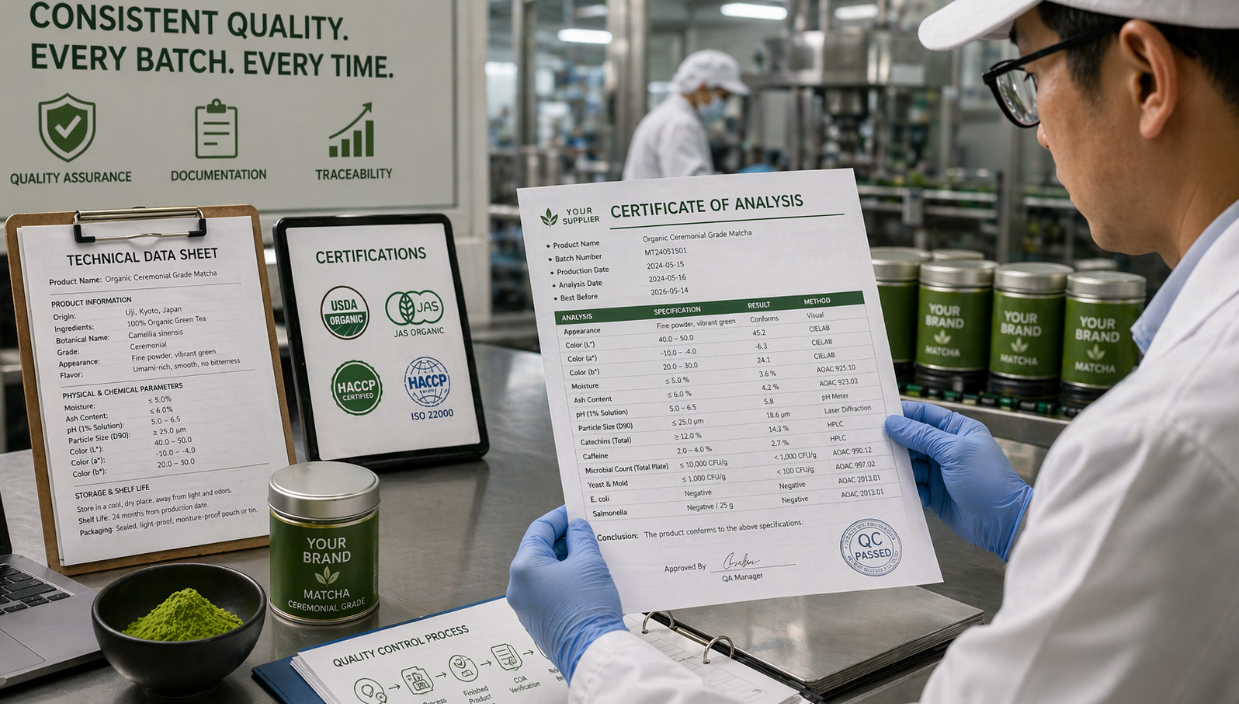
I believe that a mature supplier sells more than just matcha. They sell a verifiable quality system. The powder in the bag is the final output, but the trust is built on the data, processes, and paperwork that stand behind it. When a commercial buyer purchases from us, they are also purchasing peace of mind. They know they have the documentation to satisfy their internal QA team, their auditors, and government regulators. This "deliverable trust" is just as important as the physical product.
The Certificate of Analysis (COA)9 is Your Proof
A Certificate of Analysis, or COA, is not just another piece of paper. It is a batch-specific report card. For every single production lot we ship, we provide a COA that details the results of our quality tests—from particle size and color values to microbial counts and heavy metal analysis. This document is the buyer's proof that the specific batch they have received meets the exact specifications we agreed upon. If a supplier can't provide a batch-specific COA, you are essentially buying blind.
The Technical Data Sheet (TDS) is Your Blueprint
While the COA is specific to a batch, the Technical Data Sheet (TDS)10 is the master blueprint for the product. It lists all the standard specifications, from ingredient declarations and nutritional information to shelf life and storage conditions. Your R&D and QA teams use the TDS to qualify the ingredient for use in your facility. It's the foundational document that sets the expectations for quality and performance before you even place an order.
Traceability Connects the Farm to Your Factory
What happens if there's a problem? You need to be able to trace it back to its source. We have a full traceability system11 that allows us to track every bag of matcha back through the milling process, to the tencha leaves, and all the way to the specific plot in our tea gardens where it was harvested. This level of traceability is a core requirement for modern food safety systems like HACCP and ISO 2200012. It provides accountability and is a crucial part of any professional supply chain.
Conclusion
For commercial matcha, success depends on verifiable specs, not just grade names. Focus on application, safety, and documentation to build a reliable supply chain and a consistent product.
Understanding particle size helps ensure smooth texture and proper dispersibility in products, crucial for consistent quality. ↩
Moisture content affects shelf life, flowability, and clumping, making it essential for maintaining product stability. ↩
L*a*b* values provide measurable color consistency, ensuring every batch of matcha looks identical, vital for brand reliability. ↩
Food safety compliance ensures matcha is free from harmful contaminants, protecting consumer health and meeting regulatory requirements. ↩
Catechins provide a refreshing bitterness and astringency, balancing the flavor and adding to matcha's health benefits. ↩
L-theanine contributes to the umami taste in matcha, enhancing its savory flavor profile and consumer appeal. ↩
MRLs ensure pesticide residues in matcha are within safe limits, meeting regulatory standards for global markets. ↩
Organic certifications verify that matcha is cultivated without synthetic pesticides, appealing to health-conscious consumers. ↩
A COA provides batch-specific quality proof, ensuring the matcha meets agreed specifications for safety and performance. ↩
A TDS outlines standard specifications, helping R&D and QA teams qualify matcha for consistent use in production. ↩
Traceability ensures accountability and allows issues to be tracked back to their source, enhancing food safety and quality control. ↩
ISO 22000 certification demonstrates a supplier's commitment to comprehensive food safety management systems. ↩